A Practical Anachronism: The Hand Plane in a Contemporary Shop
By Chris Black
One of my earliest woodworking jobs was as a carpenter’s apprentice for a small family owned general contractor. I worked with the owner framing, trimming and building a variety of items in the shop. Even though we primarily used machines and power tools, we occasionally used an ECE Primus smoothing plane; a Stanley No.60 1/2 low angle block plane and a Stanley No.75 bullnose rabbet plane. We employed the smoothing plane as a general purpose tool in much the same manner as a jack plane. The Stanley block came out primarily to scribe crown molding to ceilings and walls where too much mud was used. The bullnose rabbet plane trimmed window sill joints to fit modern replacement windows. I remember trying to set a replacement window on an existing 2x4 sill with a pronounced hump in the middle of it preventing the new window from fitting. In stead of spending a lot of time tearing out the existing framing, I went to the truck to retrieve the ECE smoothing plane and knocked down the offending section with just a handful of passes. A recently hired carpenter who was more experienced than I was jokingly called me “old school.” I didn’t think anything about it. Besides I found I  enjoyed using using planes. The boss was just happy I resolved the issue quickly.

Eventually, when I opened my own carpentry and cabinetmaking business, I wound up getting similar planes that I was familiar with; a Record No.4 smoothing plane, a Stanley No.60 1/2 block plane and a Stanley No.75 bullnose rabbet plane. Working primarily in the shop I found myself relying more on machinery and power tools for speed and efficiency. It wasn’t until years later when I began to work at that famous woodworking store in Atlanta, GA that my interest in hand planes began to grow again.

My woodworking focus changed from cabinets and furniture to smaller side projects, items I could sell in local galleries and furniture for the family. I was still in the game but as I was working nights and weekends I began to rely more on hand tools to keep the neighbors from complaining about the noise and the children asleep. An unintended consequence of this change was that I started to enjoy woodworking again as the burnout of running a commercial shop began to fade. I think it must have something to do with the element of risk that hand tools and planes in particular bring to the process. With a tool that requires a certain amount of obtainable skill and dexterity, there’s a risk somewhere along the process that the project ends in disaster. Perhaps it’s here in a successful ending that the full reward of satisfaction is achieved. On a practical level, I discovered that I was more productive as a one man operator using hand planes and card scrapers for some tasks than with power tools. Sometimes a smoothing plane is faster than running through the grits on a random orbit sander and breaking corners with a block plane sure beats setting up a router with a 1/8” round over bit and blowing dust all over the shop.

Handplanes can also round out a handyman’s kit. I get regular calls from family members and neighbors who need a stuck drawer planed or a wooden door thats rubbing shaved a bit. No dust and clean up’s a breeze.

So Here’s a list of planes I actually use frequently and one I keep around just because I like them. The following are in no particular order:
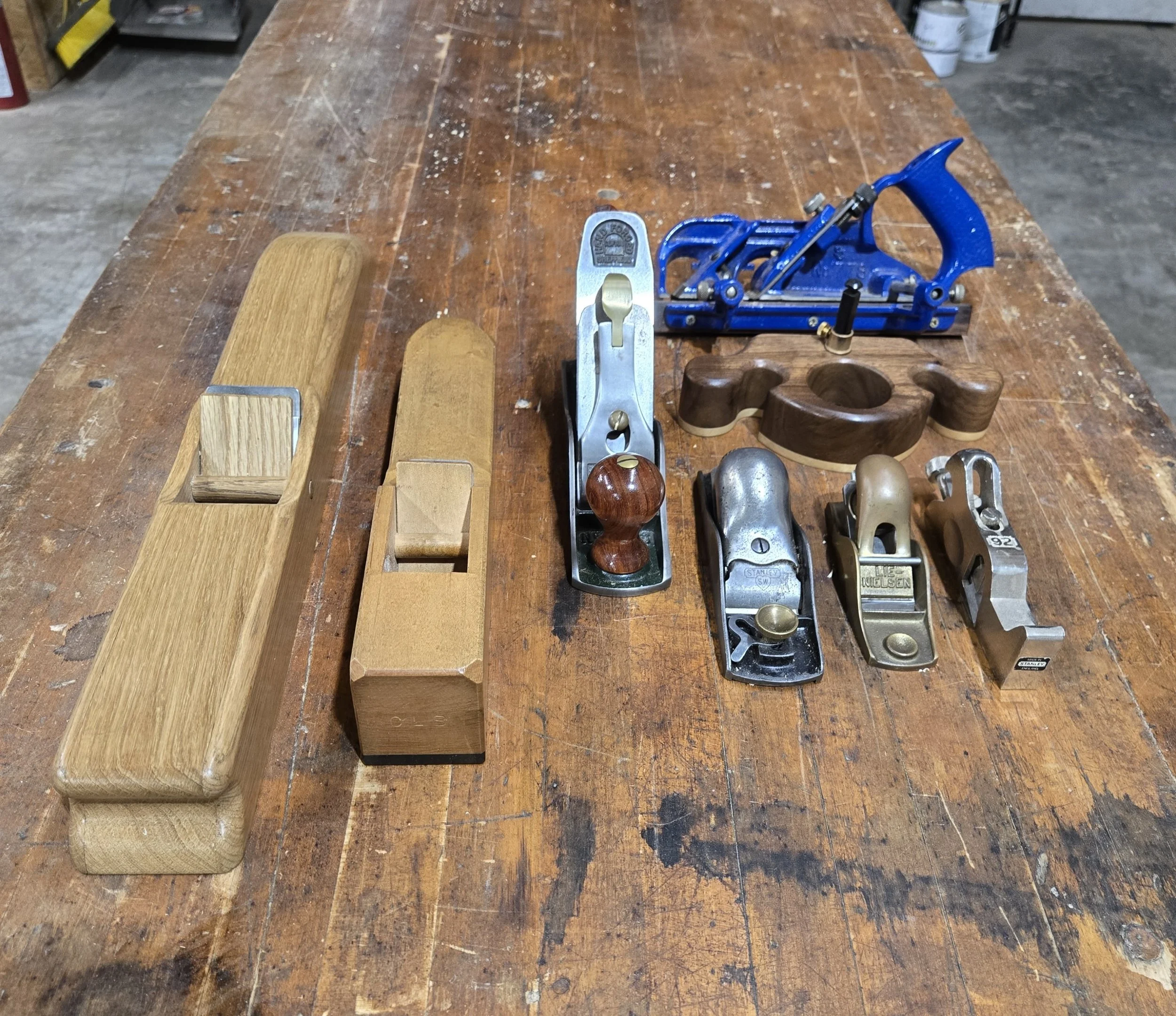
-A modern Bedrock No.3 smoothing plane. Bedrock was Stanley’s premium line of hand planes. Now several manufacturers are making their own versions of this plane. I set mine up with tight throat opening to help prevent tear out and with a slightly cambered cutting edge so the blade’s corners won’t leave witness lines.

- A shop made wooden jack plane. This Krenov style 5-piece plane is set up for coarser work. It has a wider throat opening than the smoothing plane to allow for a thicker shaving and is routinely employed to plane down a door, remove machine marks and occasionally to uncrown a joist.

-A shop made wooden jointer plane. Also in the Krenov style, this plane supplements the machine jointer in my shop. I don’t use it as often as my other 2 bench planes, but it’s handy for gluing up just a few boards and when I’m too lazy to change the blades on the machine.

-2 block planes. I have a standard angle block plane (bedded bevel up at 20 degrees) set with the blade set relatively deep for a fast cut when chamfering corners. The other block plane in a low angle version (bedded bevel up at ~15 degrees). It shoots end grain and acts as a small smoothing plane. Therefore I keep it set for the finest of cuts with the adjustable throat closed way down.

-A shoulder plane. As the name would suggest, a shoulder plane is designed to reduce a tenon’s thickness by bearing up against the tenon’s shoulder and planing the checks. I find I use it for adjusting rabbets on millwork and chamfering edges where the block plane is too clumsy.

-A selection of card scrapers. Whether I’m scraping semi-dried glue, cleaning up mill marks or simply preparing surfaces before final sanding, these tools get a ton of use.

-Router plane. Router planes are one of those planes that often get overlooked. Whether you're cleaning up a mortise for a hinge or flattening the bottom of a dado, you’ll wonder how you ever got along without it.

-A fenced rabbet plane. This plane falls under the category of I just like having it around. Rabbets are easy enough to cut with a dado blade or on a router table, but there can a lot of set up time involved. Sometimes it’s nice to clamp a board in the vise, set the fence, adjust the blade and start the cut. Using a well tuned rabbet plane can be quite satisfying.