Top 10 Woodworking Books for Reference and Inspiration
Written by Chris Black
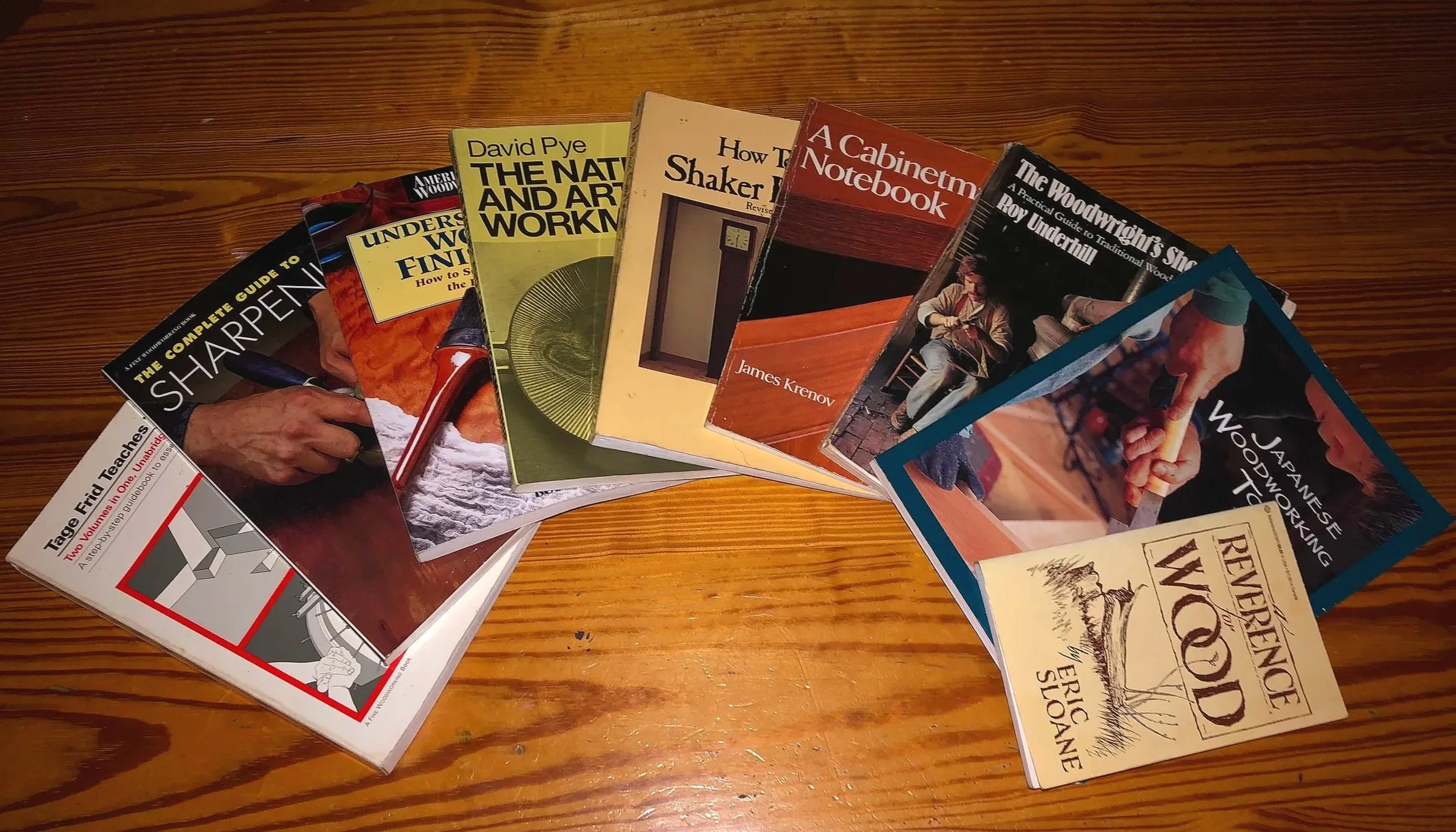
Students have often asked me which woodworking books I recommend. I usually respond by asking which subjects are they interested in: joinery, finishing, furniture construction/design, tools? Most of us probably think of woodworking books in terms of practical instruction, but what about inspiration? Knowing the size of an average place setting for a kitchen table is no good if you’re not motivated to build a table. So in no particular order here’s my list of 10 books I’ve kept on the shelf in my shop for reference and inspiration. 1. “Tage Frid Teaches Woodworking books 1 Joinery, 2 Shaping, Veneering, Finishing, 3 Furniture Making.”
I know; it’s technically 3 books. I have Tage to thank for introducing me to the card scraper and how to successfully sharpen it. That said I highly recommend using a purpose made burnisher to turn the burrs on your scraper and not the back of a chisel as Tage does for obvious safety reasons. Tage’s books are also responsible for teaching me to sharpen hand saws. I still use a version of his shop made saw filing vise. 2. “The Complete Guide to Sharpening” by Leonard Lee.
If you do any kind of woodworking, eventually you’re going to have to sharpen something especially if you plan on using hand tools. I credit Leonard Lee with fine tuning my bench grinder skills and with getting fast predictable results with Japanese water stones. 3. “Understanding Wood Finishing 3rd revised edition” by Bob Flexner.
If you ask any woodworker what’s their weakest skillset, chances are their answer will be finishing. How do I prepare wood for finishing? What’s the difference between dye stains and pigment stains? How do I decide what topcoat to use? Bob answers all these questions and more. My friend Frank, a furniture restorer, calls this book the finisher’s bible and that is why there will always be a copy in my bookcase. 4. “Nature and the Art of Workmanship” by David Pye.
There’s a reason why the next three authors quote Pye in their books. This book is a philosophical approach to craft rather than a how to. Pye challenges the conventional definition of handmade and in turn discusses the craftsmanship of risk versus the craftsmanship of certainty. A must read for any maker. 5. “How to Build Shaker Furniture” and “Measured Shop Drawings for American Furniture” by Thos Moser.
Not long after I opened my first cabinet shop I became intrigued by the furniture craftsmanship of the Shakers. I would frequently visit the Thos Moser showroom near my hometown in an attempt to measure the Shaker inspired pieces on display. At some point a salesperson informed me that Moser had published two books with measured drawings of his furniture. Needless to say, I purchased both books. 6. “A Cabinetmaker’s Notebook” by James Krenov.
Here’s another book that’s less about the how-to of woodworking and more about his approach and mindset toward art and craft. Krenov’s thoughtful work definitely embodies Pye’s craftsmanship of risk, surface diversity and personal detail. I think everyone after reading Notebook, as his students call it, goes through a Krenov phase on some level. For me it’s about the details like his carved pulls and hand planed surfaces. 7. “The Woodwright’s Shop” by Roy Underhill.
This book and his PBS show by the same name arguably ignited the handtool movement in woodcraft. With this you can do this enthusiasm and engaging style Roy will have you sharpening your grandfather’s axe and getting to work. 8. “A Reverence for Wood” by Eric Sloane.
Sloane discusses not only the practical characteristics of different wood species as a resource but the awe and respect early American’s had with the material. This book is well illustrated with Sloane’s superb drawings. 9. “Japanese Woodworking Tools: Their Tradition, Spirit and Use” by Toshio Odate.
When I was an apprentice carpenter I wanted to build my own work bench. I decided to purchase a backsaw for the tenons at the tool department of a well known department store. Full of anticipation, I got home, laid out the joints and started ripping the tenon cheeks. Things didn’t go well. It cut slowly, the handle was uncomfortable and it didn’t track properly. I learned about Japanese saws from Toshio Odate’s book, so I took a chance and ordered a dozuki from a mail order catalog. It worked brilliantly and I’ve been using Japanese saws for joinery ever since. Over the years this book has motivated me to try my hand at making my own tools including planes, marking gauges and chisels. 10. “The Handplane Book” by Garrett Hack.
One of my favorite parts of woodworking is planing a really great piece of wood with a well tuned handplane. It epitomizes the craftsmanship of risk and all its intrinsic rewards. Hack celebrates the history and artistry of handplanes while offering practical advice on how to get them up and working to their full potential.